
HANGARED DOES NOT MEAN PROTECTED
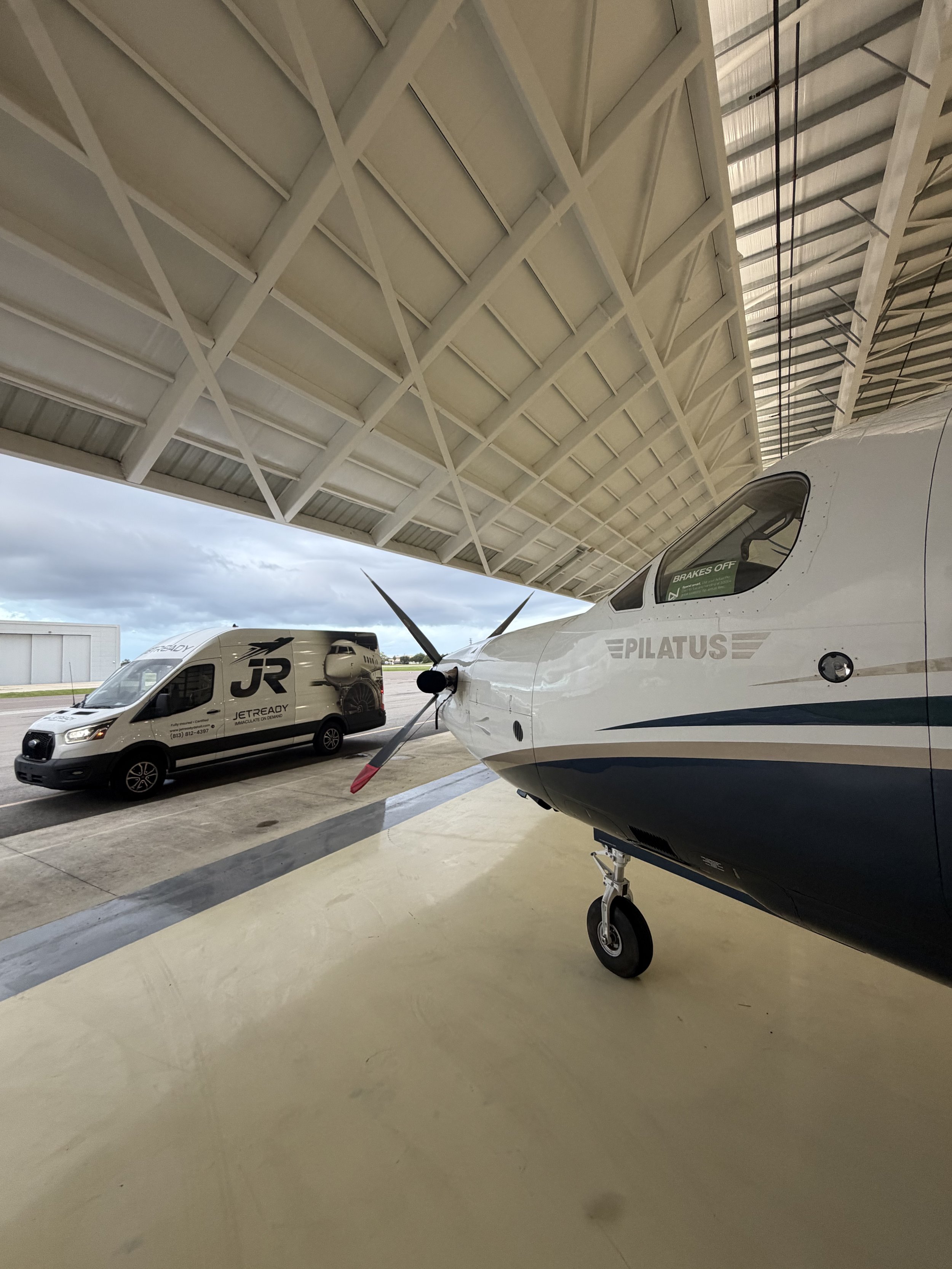
A HANGAR IS PROTECTION — NOT DECONTAMINATION
Keeping an aircraft hangared is one of the best steps an owner can take to protect it from direct sun, rain, wind, and continuous outdoor exposure.
But putting an aircraft inside does not reset what happened outside.
An aircraft may return to the hangar carrying:
Salt from coastal operations
Moisture and humidity
Exhaust residue
Oils and belly contamination
Bugs and organic material
Runway and ramp contaminants
Once the hangar doors close, those contaminants do not automatically disappear.
WHAT THE FAA WARNS ABOUT
In the May/June 2022 FAA Safety Briefing, aircraft renovation expert Dennis Wolter describes a particularly important combination:
Humidity + salt exposure + extended storage in a damp hangar can create ample opportunity for corrosion.
The article also explains that an aircraft does not need to live beside the ocean to experience salt-related corrosion.
Even temporary exposure to salt air can leave salt crystals behind after the aircraft returns home.
That changes how we should think about hangaring.
The hangar protects the aircraft from additional exposure. It does not remove exposure that has already occurred.
The FAA even recommends washing an aircraft after ocean exposure and keeping landing gear wells and aircraft bellies clean and degreased.
WHY THIS MATTERS IN FLORIDA
Florida aircraft regularly operate in an environment where moisture and coastal exposure are difficult to avoid.
An aircraft may spend most of its life inside a premium hangar while regularly flying through Tampa Bay, Sarasota, Naples, Fort Myers, Miami, Palm Beach, Jacksonville, or other coastal areas.
During operation, it can encounter:
High humidity
Salt-containing coastal air
Rain and condensation
Exhaust contamination
Bugs and organic deposits
Oils and operational residue
A hangared aircraft can therefore still require consistent exterior care.
The better question is not simply:
“Is the aircraft hangared?”
It is:
“What condition is the aircraft in when it enters the hangar?”
SOME OF THE MOST IMPORTANT AREAS ARE NOT THE MOST VISIBLE
FAA guidance identifies cabin areas as particularly corrosion-prone and emphasizes keeping unwanted moisture out of the aircraft.
Attention should also be given to areas such as:
Door and window seals
Floors and carpets
Seat rails
Lower cabin areas
Landing gear wells
Aircraft bellies
Seams and difficult-to-access areas
This reinforces an important principle:
A glossy aircraft sitting inside a hangar does not necessarily tell the entire preservation story.
THE JETREADY APPROACH: PROTECTION BEYOND THE HANGAR
At JetReady, we view hangaring as one layer of protection—not the entire strategy.
A stronger preservation approach combines:
Controlled Cleaning → Surface Protection → Recurring Maintenance → Proper Storage
Once contamination has been properly removed, protecting the aircraft’s exterior finish can add another important layer between the paint and its operating environment.
CERAMIC COATING: LONG-TERM EXTERIOR PROTECTION
JetReady’s Ceramic Protection Program is designed to protect and preserve properly prepared aircraft paint.
The coating chemically bonds with the paint surface to create a durable, hydrophobic and slick protective layer that helps repel water and contaminants while making routine cleaning easier.
For aircraft operating in Florida, this is particularly relevant because exterior surfaces regularly encounter:
Coastal salt
High humidity
Frequent rainfall
UV exposure
Bugs and organic contamination
Exhaust and environmental residue
Ceramic coating does not make an aircraft immune to corrosion.
It also does not protect hidden structural areas or untreated components.
Its role is to provide an additional protective barrier over the exterior finish while helping contaminants release more easily during future maintenance.
That is why JetReady structures ceramic coating as a protection program rather than a one-time application.
Our program incorporates ongoing maintenance, documentation, and care standards designed to preserve coating integrity and long-term finish quality.
POLYMER SEALANT: A FLEXIBLE PROTECTION OPTION
Not every aircraft requires a long-term ceramic coating installation.
JetReady’s Polymer Sealant provides another option for owners and operators who want additional exterior protection with a more flexible maintenance approach.
A polymer sealant creates a temporary sacrificial protective layer over the aircraft finish.
It can help:
Reduce direct environmental exposure to the paint
Improve water behavior
Make routine contamination removal easier
Enhance gloss and surface slickness
Support recurring exterior preservation
Unlike a ceramic coating, polymer protection gradually wears away and therefore requires periodic reapplication.
For some aircraft and operating profiles, that makes polymer sealant an effective part of a recurring maintenance program.
PROTECTION DOES NOT ELIMINATE CLEANING
Ceramic coating and polymer sealant do not mean an aircraft can be coated, placed inside a hangar, and forgotten.
Salt, bugs, exhaust residue, oils, and environmental contamination still need to be removed.
Protective products perform best when they are maintained properly.
This is why JetReady combines protective treatments with disciplined recurring aircraft care.
The objective is not simply:
Protect it once.
The objective is:
Clean it consistently → Protect the surface → Maintain the protection → Store it properly.
CONTROLLED CLEANING STILL MATTERS
For appropriate aircraft and operating conditions, JetReady utilizes controlled rinseless exterior cleaning to remove contamination while limiting unnecessary amounts of free water around the aircraft.
Our wet-and-dry process further allows aviation-safe cleaning products to be followed with a separate clean, dry towel to remove remaining residue and moisture.
The principle remains consistent throughout our services:
Use the least aggressive process necessary to safely achieve the required result.
THE SAME DISCIPLINE APPLIES INSIDE THE CABIN
Exterior protection is only one part of aircraft preservation.
When carpet or textile cleaning requires moisture, JetReady uses controlled low-moisture cleaning methods rather than unnecessary saturation.
During applicable interior services, we also use air movement and dehumidification to support drying and reduce the amount of time cleaned materials remain damp.
The objective is to clean effectively while controlling unnecessary moisture inside the cabin.
A HANGAR WORKS BEST AS PART OF A SYSTEM
The FAA notes that proper hangar storage can provide significant corrosion-control benefits.
But storage works best alongside other preventive measures.
For JetReady, that means thinking about aircraft preservation as a complete system:
Protected Storage
Consistent Contamination Removal
Ceramic or Polymer Surface Protection When Appropriate
Recurring Professional Care
Qualified Aircraft Inspection and Maintenance
No single step replaces the others.
DETAILING SUPPORTS PRESERVATION — IT DOES NOT REPLACE MAINTENANCE
Professional aircraft cleaning and exterior protection can support paint preservation, remove contamination, improve visibility, and help maintain the aircraft’s condition.
They do not replace corrosion inspections, structural evaluation, OEM maintenance procedures, or repairs performed by qualified aviation maintenance personnel.
Ceramic coatings and polymer sealants protect only the surfaces to which they are properly applied.
They do not protect hidden structural areas, internal cavities, untreated components, or existing corrosion.
If JetReady identifies corrosion, coating failure, unusual staining, compromised fasteners, moisture concerns, or another condition requiring maintenance evaluation, the appropriate next step is inspection by qualified maintenance personnel.
KEY TAKEAWAY
A hangar protects an aircraft from additional environmental exposure—but it cannot remove contamination already present.
The strongest strategy combines proper storage, consistent cleaning, appropriate exterior protection, and professional aircraft maintenance.
SOURCE & FURTHER READING
Federal Aviation Administration — FAA Safety Briefing, May/June 2022