
YOUR AIRCRAFT DOES NOT HAVE TO LOOK DIRTY TO BE AT RISK
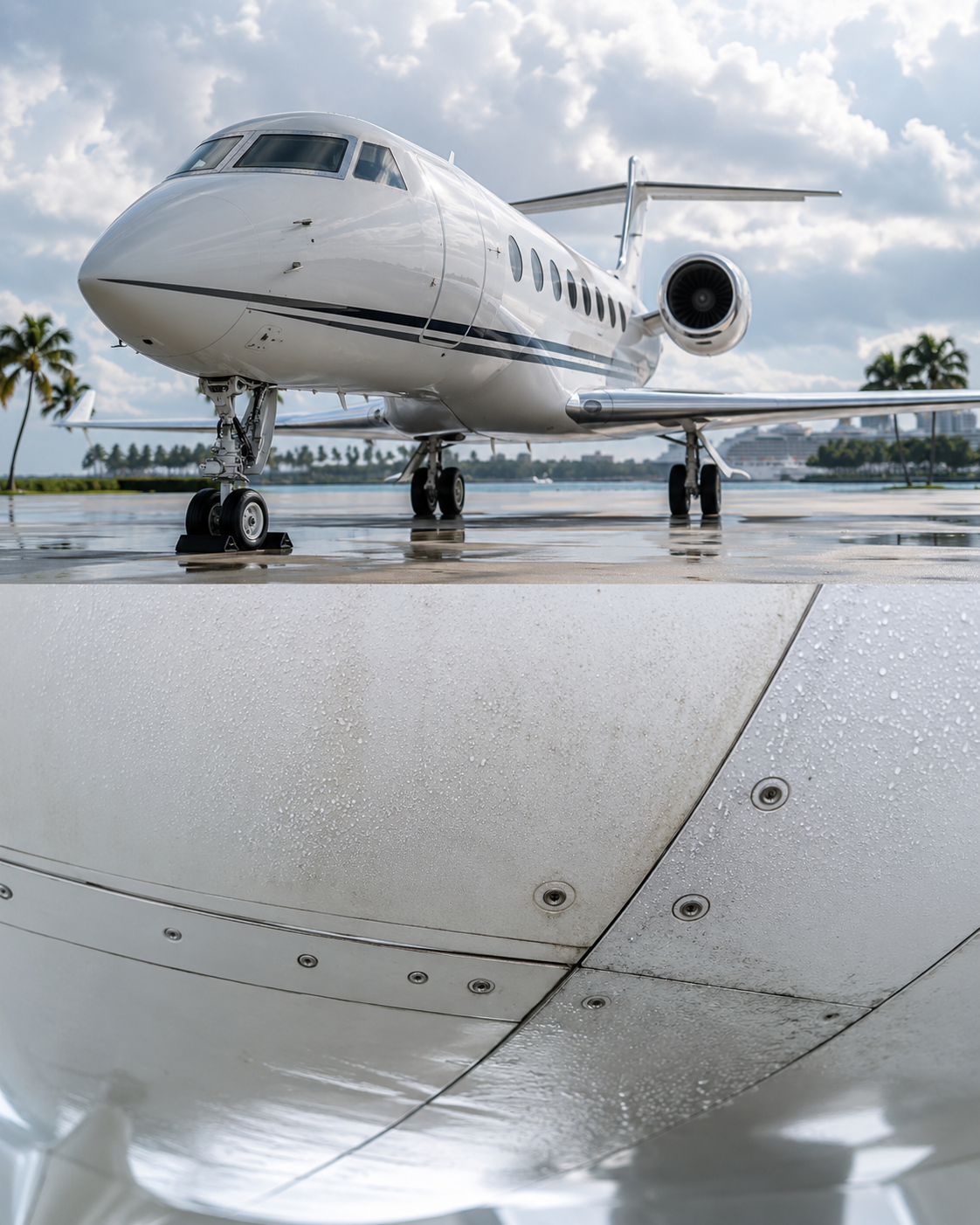
CLEAN DOES NOT ALWAYS MEAN CONTAMINANT-FREE
Aircraft corrosion does not necessarily begin with something dramatic enough to notice from across the hangar.
According to FAA Advisory Circular AC 43-4B, electrolytes can form when condensation, salt spray, rain, or rinse water accumulate on aircraft surfaces. Dirt, salt, acidic gases, and engine exhaust can then dissolve into that moisture, increasing its electrical conductivity and potentially accelerating corrosion. (Federal Aviation Administration)
That means an aircraft can still look relatively clean while the conditions necessary for corrosion are developing at a much smaller level.
Visible appearance tells only part of the story.
WHERE CONTAMINATION CAN BECOME MORE SERIOUS
The FAA also identifies areas where moisture and contamination can become confined—such as faying surfaces and deep crevices—as locations where corrosion may progress more rapidly. (Federal Aviation Administration)
Exhaust areas deserve particular attention.
FAA guidance describes both jet and reciprocating-engine exhaust deposits as highly corrosive and notes that residue can become trapped around gaps, seams, hinges, fairings, rivet heads, and skin crevices, including locations ordinary cleaning may not easily reach. (Federal Aviation Administration)
This is why aircraft care should not begin only when the aircraft looks dirty.
WHY THIS MATTERS IN FLORIDA
Florida adds another layer to the equation.
Aircraft operating around coastal environments can be exposed to humidity, salt-containing air, rain, condensation, exhaust residue, bugs, oils, and other environmental contamination.
Some of these deposits may be obvious.
Others may leave very little visual evidence initially.
The important question is therefore not simply:
“Does the aircraft look dirty?”
A better question is:
“What has the aircraft been exposed to since it was last properly cleaned?”
THE JETREADY APPROACH: CONTROL CONTAMINATION BEFORE IT BUILDS
JetReady approaches aircraft cleaning as part of an ongoing preservation strategy rather than waiting for visible buildup.
Controlled Rinseless Cleaning
Whenever appropriate for the aircraft and its condition, we utilize a professional rinse-less wash process that allows us to remove contamination while limiting unnecessary amounts of free water around the aircraft.
Our objective is not to flood a surface and then remove the water.
It is to use a controlled cleaning process that addresses contamination while maintaining tighter control around seams, openings, fasteners, sensors, windows, and other sensitive areas.
Wet-and-Dry Cleaning Method
For many aviation-safe cleaning products, JetReady uses a two-step wet-and-dry process.
A damp or product-treated towel performs the cleaning step. A separate clean, dry towel follows to remove remaining residue, contamination, and moisture.
The goal is to avoid leaving unnecessary chemical or moisture behind after the cleaning step is complete.
Attention to High-Contamination Areas
Belly surfaces, exhaust trails, landing gear areas, seams, leading edges, and other high-exposure areas may require more attention than their appearance initially suggests.
Removing this contamination regularly helps maintain a cleaner surface and can make changes in the aircraft’s condition easier to identify.
CLEANING SUPPORTS INSPECTION—IT DOES NOT REPLACE IT
Professional detailing is not a corrosion inspection, structural evaluation, or substitute for manufacturer-required maintenance.
FAA guidance makes clear that corrosion inspection frequency, identification, and treatment remain the responsibility of the operator and should follow applicable manufacturer recommendations and maintenance programs. (Federal Aviation Administration)
JetReady’s role is different:
Remove contamination carefully, control unnecessary moisture, improve surface cleanliness, and support the long-term preservation of the aircraft.
If we identify corrosion, coating failure, unusual staining, damaged fasteners, or another maintenance concern during service, the aircraft should be evaluated by qualified maintenance personnel.
KEY TAKEAWAY
An aircraft does not have to look dirty for contamination to be present. Consistent, controlled cleaning addresses exposure before visible buildup becomes the reason to act.
SOURCE & FURTHER READING
Federal Aviation Administration — AC 43-4B, Corrosion Control for Aircraft