
PROTECTING THE ASSET: HOW PROFESSIONAL AIRCRAFT DETAILING HELPS PRESERVE AIRCRAFT VALUE
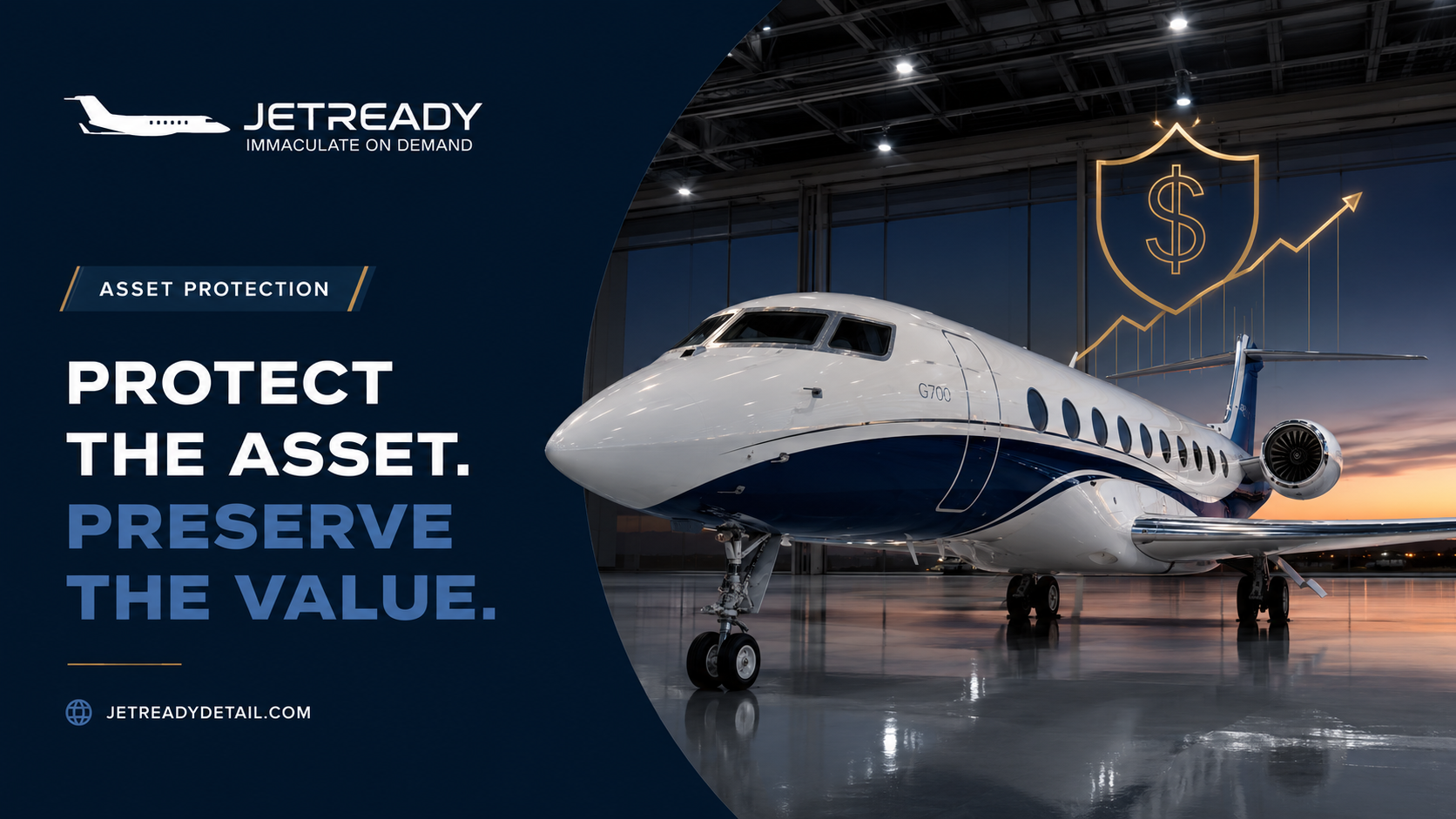
An aircraft is more than a transportation tool. It is a high-value capital asset whose condition is evaluated every time it is operated, financed, appraised, chartered, or offered for sale.
Professional aircraft detailing protects and enhances that condition. Paint enhancement can restore finish clarity, while aviation-specific ceramic coating adds durable surface protection, reduces contaminant adhesion, and helps preserve a premium, market-ready aircraft.
The visible result may be a cleaner, glossier aircraft. The larger purpose is asset protection.
Key takeaway: Professional aircraft detailing creates real ownership value by protecting exterior paint, preserving cabin materials, improving presentation, reducing the effects of contamination, and helping the aircraft remain in premium condition over time.
Condition Is Part of the Valuation Equation
Aircraft value is influenced by numerous factors, including model demand, airframe hours, engine status, maintenance programs, avionics, damage history, records, and current market conditions. Overall condition is also a recognized part of the equation.
AOPA Aviation Finance identifies the aircraft’s overall condition—including both its exterior and interior—as a determinant of value. It also explains that recent paint and interior work may add value during an aircraft valuation.
AOPA’s aircraft-buying guidance similarly states that properly completed paint and interior work enhances aircraft value. VREF Aircraft Values & Appraisals goes further, identifying exterior paint condition as an essential valuation factor and explaining that deep interior cleaning and detailing can improve an aircraft’s value by making it more appealing to prospective buyers.
This is why detailing should not be separated from asset management. Appraisers, lenders, brokers, buyers, passengers, and flight departments all encounter the aircraft’s condition. A finish that is clean, protected, and professionally maintained communicates a very different ownership history than one showing embedded exhaust, oxidation, staining, deteriorated gloss, or a neglected cabin.
Aircraft Paint Is a Protective System
Aircraft paint is not simply decoration.
The FAA’s Corrosion Control for Aircraft guidance explains that paint systems protect exposed aircraft surfaces against corrosion and other forms of deterioration. The primer provides adhesion and corrosion-inhibiting properties, while the topcoat supplies weather resistance, chemical resistance, durability, and color.
The National Business Aviation Association also emphasizes that aircraft paint protects against moisture, dirt, pollutants, salt, and sunlight. NBAA’s paint professionals warn that chipped, cracked, or improperly maintained paint can expose the aircraft to progressively more expensive problems.
Once paint begins losing its protective qualities, the solution may eventually move beyond detailing into paint repair, stripping, or complete refinishing. Protecting a serviceable paint system before it reaches that point can create substantial ownership value.
Contamination Should Not Be Allowed to Become Part of the Finish
Aircraft routinely accumulate contaminants such as:
Exhaust residue
Insects and organic material
Oil, grease, and hydraulic-fluid residue
Ramp dirt and atmospheric pollution
Salt and mineral deposits
Bird residue and environmental fallout
These substances do more than make an aircraft look dirty. Some can stain or bond to the finish, retain moisture, interfere with inspection visibility, and become more difficult to remove the longer they remain.
The FAA explains that dirt, salt, acidic gases, and engine-exhaust gases can dissolve on wet surfaces and increase conditions favorable to corrosion. Its corrosion-control guidance includes regularly scheduled aircraft washing, periodic thorough cleaning, and early attention to damaged protective coatings.
This does not mean washing alone prevents every corrosion problem. It means controlled, recurring cleaning is part of responsible surface preservation.
It also matters how the aircraft is cleaned. The FAA cautions that increasing cleaning-chemical concentration can cause more harm than good and advises following manufacturer recommendations. Professional detailing therefore requires aviation-appropriate products, correct dilution, controlled techniques, protection of sensitive areas, and knowledge of the materials being serviced.
Paint Enhancement Creates More Than Shine
Over time, an aircraft’s finish can lose clarity because of oxidation, environmental exposure, fine surface defects, improper washing, and embedded contamination.
When the paint system’s condition permits, professional paint enhancement can safely improve gloss, color depth, reflectivity, and overall uniformity. The aircraft does not merely photograph better—the existing finish becomes more presentable and can remain serviceable longer when followed by appropriate protection and maintenance.
That creates practical asset value by:
Improving the aircraft’s current presentation
Restoring clarity to an otherwise tired-looking finish
Helping postpone premature refinishing
Preparing the surface for durable protection
Supporting a stronger market-ready condition
The correct process must always be selected according to the aircraft’s paint type, age, condition, previous work, and manufacturer guidance. Aggressive automotive methods have no place on an aircraft simply because they produce a fast visual result.
Ceramic Coating Adds a Higher Level of Paint Protection
Specialized aircraft detailing can create additional value through professionally installed ceramic protection.
An aviation-appropriate ceramic coating creates a durable protective layer over a properly prepared paint system. It can reduce the adhesion of dirt, bugs, exhaust residue, and environmental contamination while making recurring cleaning faster and less aggressive.
Major aviation MRO provider West Star Aviation identifies several benefits of aircraft ceramic and titanium coatings, including improved paint longevity, resistance to dirt and exhaust residue, easier cleaning, protection against UV-related oxidation and fading, and increased resale value through preservation of exterior condition.
That is real ownership value. The aircraft becomes easier to maintain, premium presentation lasts longer, and exposure-related deterioration can be better controlled.
However, ceramic coating is not a substitute for paint repair or corrosion treatment. It must be applied over a properly evaluated and prepared finish. Existing paint failure, suspected corrosion, damaged sealant, leaks, or structural concerns must be referred to appropriately qualified maintenance or paint professionals.
The Cabin Is Also Part of the Asset
Asset protection does not stop at the cabin door.
Leather, carpet, headliners, cabinetry, plastics, decorative finishes, and high-touch surfaces all influence how passengers and prospective buyers perceive the aircraft. Stains, dried or cracked leather, odors, damaged carpet, and neglected cabinetry can quickly reduce the impression of quality.
VREF specifically identifies interior condition as an aircraft-value factor and notes that stains, cracked leather, and damaged cabinetry can negatively affect value. Proper deep cleaning and detailing can improve buyer appeal and contribute positively to the aircraft’s presentation.
Material-appropriate cabin care helps:
Preserve leather and decorative surfaces
Prevent spills and soil from becoming permanent
Maintain a premium passenger environment
Reduce odors and accumulated contamination
Keep the cabin prepared for executive, charter, or resale presentation
For a high-value aircraft, the passenger experience and the asset’s condition are closely connected.
Florida Makes Consistent Protection Even More Important
Florida aircraft operate in an especially demanding environment. High humidity, intense UV exposure, frequent rain, coastal salt, insects, heat, and outdoor ramp exposure can repeatedly challenge both exterior and interior materials.
The FAA specifically states that aircraft exposed to salt air or over-water operations require a more stringent corrosion-control program than aircraft operating in a dry environment.
This makes consistency more valuable than occasional correction. An aircraft that receives scheduled, exposure-based care is easier to protect than one serviced only after staining, oxidation, or contamination becomes severe.
The appropriate maintenance frequency should consider:
Hangared versus outdoor storage
Coastal and over-water exposure
Aircraft utilization
Flight frequency and destinations
Paint and coating condition
Manufacturer and operator requirements
What Professional Detailing Can—and Cannot—Do
Professional detailing can preserve paint, improve finish clarity, protect surfaces, maintain cabin materials, remove harmful contamination, and help make visible surface abnormalities easier to notice.
Detailing can also document visible conditions and alert the owner, operator, or maintenance team to concerns such as paint bubbling, cracking, unusual residue, staining, sealant deterioration, or suspected corrosion.
Professional detailing does not replace an FAA-required inspection, an A&P technician, an authorized repair station, an aircraft paint facility, or an OEM maintenance program. A detailer should report visible concerns—not diagnose, repair, or conceal them.
This distinction protects both the aircraft and its owner.
The JetReady Asset-Protection Approach
JetReady approaches aircraft detailing as planned condition management.
Our services may include controlled exterior cleaning, contaminant removal, paint enhancement, aviation-specific ceramic protection, premium cabin detailing, and recurring maintenance designed around the aircraft’s environment and operational schedule.
The goal is not temporary shine. It is to protect expensive materials, maintain a premium presentation, support easier ongoing care, and preserve the condition that contributes to the aircraft’s ownership and market value.
Protect the Condition Before Restoration Becomes the Only Option
Aircraft owners understand the value of preventive action. Waiting until a finish is heavily oxidized, permanently stained, contaminated, or failing usually limits the available options and increases the cost of correction.
Professional aircraft detailing is asset protection because it addresses condition while that condition can still be preserved and enhanced.
A clean aircraft looks better.
A properly protected aircraft is a better-maintained asset.
Protect the asset. Preserve the condition. Enhance the value.